Ghaggar River Overflow Creates Havoc in Sirsa
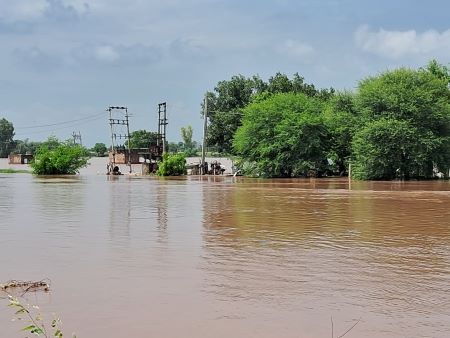
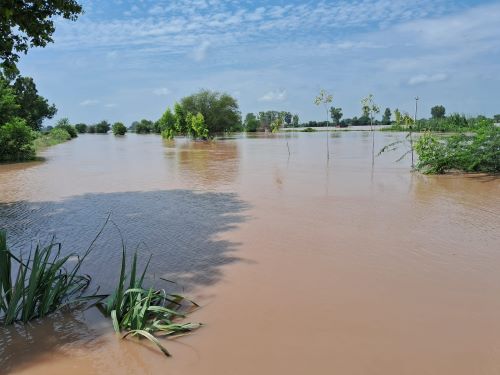
The Ghaggar River, swollen by continuous monsoon rainfall, has wreaked havoc in Sirsa district of Haryana, submerging nearly 7,000 acres of standing crops across 12 villages. The incident has left thousands of farmers distressed as their hard work over the past few months has been washed away in just a few days.
According to local officials, the affected villages include Panihari, Burj Karmgarh, Farwai Khurd, Farwai Kalan, Nejadela Kalan, Ahmedpur, Dhani Sukhchain, Kelnia, Jhorarnali, Mallewala, Saharni, and Nejadela Khurd.
Villagers Struggle to Contain Floodwaters
On Sunday, while water levels slightly receded at Sardulgarh, the situation remained alarming. A breach in the riverbank at Panihari prompted villagers to come together and attempt patchwork repairs. Despite the efforts, waterlogging has already destroyed large sections of farmland.
In Mallewala village, local social organisations and volunteers stepped in to deliver food and essential supplies to stranded residents. Many families had to leave their homes temporarily and take shelter in safer locations.
Farmers Lament Crop Destruction
For farmers in Sirsa, this flood is nothing short of a nightmare. Mahender Singh, a smallholder farmer, shared his grief:
“We planted bottle gourd, okra, and ridge gourd; now, it’s all gone.”
Vegetable crops such as gourds, okra, and ridge gourd were among the worst affected, along with paddy and cotton plantations. Farmers, who had invested heavily in seeds, fertilizers, and labor, are now staring at massive losses with no immediate recovery in sight.
A Recurring Flood Threat in Sirsa
The Ghaggar River floods are not a new phenomenon for Sirsa. Historical data highlights repeated flooding in the years 1976, 1981, 1993, 2004, and 2010. Each time, the overflowing river caused widespread destruction of agricultural land, homes, and village infrastructure.
In 2010, more than 30,000 acres of crops were destroyed when the river breached its banks, leaving thousands of families dependent on government aid and relief camps.
Why Does the Ghaggar River Flood Repeatedly?
Experts point out that the Ghaggar is not a perennial river but a seasonal stream. Its water level surges during the monsoon season due to heavy rainfall in Himachal Pradesh, Punjab, and Haryana.
The river’s tributaries, such as the Markanda and Tangri, further contribute to sudden water inflows. This seasonal swelling, combined with inadequate flood management infrastructure in certain areas, often results in overflow and crop damage.
Role of the Ottu Weir in Flood Control
A key structure in flood management is the Ottu Weir, located near Ottu village in Sirsa. Built in 2002, this weir can manage up to 40,000 cusecs of water and directs excess flow toward Rajasthan.
While the weir has reduced flood threats to a large extent in recent years, it has not been foolproof. During past flood years like 1993 and 2010, water overflow bypassed containment measures, leading to massive agricultural destruction.
Government and Local Response
The district administration has deployed disaster management teams to monitor the situation and provide relief. Food packets, drinking water, and temporary shelters have been arranged for affected villagers.
Officials have also assured farmers that a survey of crop damage will be conducted soon, and compensation will be distributed under the state government’s disaster relief policy.
Social organisations, youth volunteers, and local panchayats are also working hand-in-hand to provide immediate relief support in remote villages.
Expert Opinions on Preventive Measures
Experts emphasize the need for long-term flood management strategies in Sirsa and adjoining districts:
- Strengthening embankments along the Ghaggar River
- Expanding storage capacity of the Ottu Weir
- Setting up early warning systems for floods
- Scientific riverbed management to ensure smooth water flow
- Insurance support for farmers to cope with unexpected losses
Without such measures, experts warn that the Ghaggar will continue to threaten agriculture and livelihoods in Haryana and Punjab.
Key Impact of Ghaggar Floods in Sirsa
- 7,000 acres of crops destroyed across 12 villages
- Vegetable and cotton farmers worst affected
- Villagers forced to take shelter in safer areas
- Local volunteers providing food and aid
- History of repeated floods in Sirsa district
- Compensation survey announced by government
Future Outlook for Farmers
For farmers of Sirsa, the monsoon season brings both blessings and risks. While rains are essential for agriculture, unchecked floods like this one bring devastation. With climate change leading to more unpredictable rainfall patterns, the risk of Ghaggar floods may further increase in the coming years.
Unless strong infrastructure upgrades and flood management plans are implemented, the rural economy of Sirsa will continue to suffer every few years due to seasonal flooding.
Conclusion
The Ghaggar River floods in Sirsa have once again highlighted the vulnerability of farmers to natural disasters. With thousands of acres of crops submerged, rural families are facing immense losses. While immediate relief efforts are underway, long-term strategies and preventive measures are the only way to ensure that such destruction is minimized in the future.
For now, the farmers of Sirsa district can only hope that the government steps in quickly with compensation and strong infrastructure planning to prevent another repeat of this tragedy.