
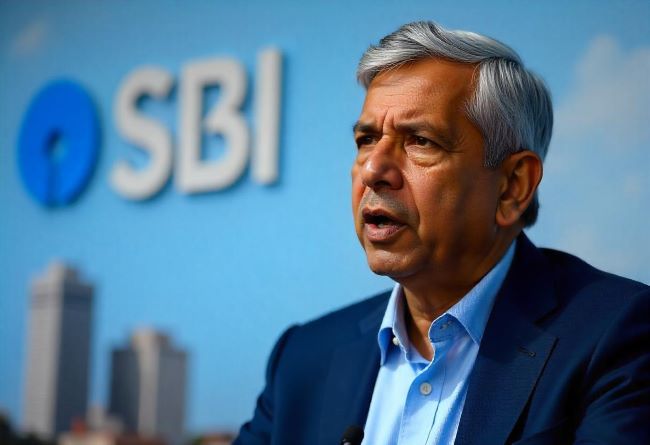
SBI Expects Margin Pressure Due to Possible 50 bps Rate Cut in Upcoming RBI Monetary Policy
Mumbai: In a crucial statement that underscores the challenges ahead for the banking sector, State Bank of India (SBI) Chairman CS Setty on Friday said that further rate cuts by the Reserve Bank of India (RBI) could lead to pressure on bank margins,
especially for the country’s largest lender. Speaking at the post-earnings press conference, Setty noted that SBI expects a 50 basis points (bps) rate cut, which may significantly impact net interest margins (NIMs) due to the timing mismatch in loan and deposit repricing.
Key Highlights:

- SBI anticipates 50 bps rate cut by RBI in upcoming monetary policy.
- Immediate repricing of loan portfolio likely post policy rate cut.
- Deposit cost adjustment lags by 12-18 months, impacting margins.
- Net interest margins under pressure in the near term.
RBI Rate Cut Expectations Mounting
With inflation easing and global central banks leaning towards monetary easing, expectations of a rate cut by the Reserve Bank of India have been gaining ground.
Industry experts and banks alike foresee at least a 50 basis points reduction in repo rate in the upcoming RBI monetary policy review.
Chairman CS Setty acknowledged this trend, stating, “We expect another 50 base point rate cuts, which means there is definitely going to be some pressure on the margins.”
Why Rate Cuts Affect Bank Margins
1. Immediate Repricing of Loan Portfolios
As per Setty, once the RBI announces a policy rate cut, many loans, especially those linked to external benchmarks, get repriced immediately, resulting in lower interest income for banks.
These floating-rate loans are directly tied to the repo rate or other policy rates, meaning any downward revision by the central bank reduces the bank’s earnings from such loans.
2. Lag in Repricing of Deposits
In contrast, deposit rates do not adjust as quickly. Banks need time — typically 12 to 18 months — to recalibrate their deposit cost structures.
Term deposits, which make up a significant chunk of a bank’s liabilities, are locked in at pre-existing rates, even as the returns from loans drop due to the repo rate cut.
3. Impact on Net Interest Margins (NIMs)
This mismatch in the repricing cycle — loans adjusting faster than deposits — is the primary reason bank margins suffer post a rate cut.
Net Interest Margin, a key profitability metric, gets squeezed when interest income falls faster than the cost of funds.
Setty emphasized, “This lag impact will be having some margin pressure.”
SBI Financial Performance at a Glance

Despite the looming margin pressure, SBI posted a strong financial performance in the recent quarter. Key takeaways include:
- Net profit growth driven by robust loan growth and lower provisioning.
- Asset quality improved, with a decline in gross and net NPAs.
- Loan book expansion across retail, corporate, and MSME segments.
- Stable credit-to-deposit ratio, indicating healthy liquidity management.
However, Setty cautioned that the favorable interest rate cycle, which previously boosted NIMs, might no longer be as supportive going forward.
Sector-Wide Concerns Over Margin Squeeze
RBI’s Monetary Policy Outlook
The RBI’s next monetary policy is expected to be influenced by:
- Moderation in CPI inflation.
- Global economic slowdown.
- Monetary policy moves by US Federal Reserve and European Central Bank.
- A need to stimulate credit growth amid economic uncertainties.
Should the RBI proceed with a 50 bps rate cut, it could set a precedent for banks to lower lending rates, thereby aiding borrowers but putting profitability under strain for lenders.
Banking Sector May See Widespread NIM Compression
Apart from SBI, other public and private banks are also bracing for net interest margin compression. Analysts suggest that the entire sector might see pressure unless loan growth significantly outpaces deposit cost increases.
Strategic Response by SBI and Other Banks
To mitigate margin pressure, banks like SBI are considering several strategic measures:
- Increasing focus on fee-based income to diversify earnings.
- Rebalancing loan portfolios towards higher-yielding segments like retail loans.
- Promoting CASA (Current Account Savings Account) deposits to lower funding costs.
- Utilizing digital banking channels to reduce operational costs and boost efficiency.
What It Means for Borrowers and Investors
Borrowers:

- Likely to benefit from lower lending rates on home loans, personal loans, and MSME credit.
- May see reduction in EMIs, improving affordability.
Investors:
- Need to watch out for pressure on bank profitability.
- Banking stocks may see volatility based on margin outlook and RBI policy stance.
- Long-term investors should assess asset quality trends and capital adequacy before taking positions.
Conclusion: Navigating the Changing Interest Rate Environment
As the Indian economy gears up for a potential monetary easing cycle, banks like SBI face the dual challenge of balancing credit growth with profitability.
Chairman CS Setty’s remarks bring attention to the structural realities of the Indian banking system, where interest rate transmission can both stimulate the economy and simultaneously pressure banking margins.
In the months ahead, how effectively SBI and other lenders manage the lag in deposit repricing and protect their NIMs will be key to sustaining earnings momentum.