
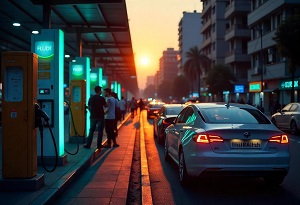
India Poised for Fuel Transition Amid Rising Demand
Bengaluru – In a significant forecast regarding India’s future energy landscape, Reliance Industries Ltd., the country’s top private refiner, announced that India’s gasoline consumption is expected to peak by 2035,
with diesel demand (gasoil) reaching its peak around 2041 or later. This prediction aligns with India’s long-term carbon neutrality goal by 2070, signaling a crucial shift towards cleaner, alternative fuels.
Key Highlights: India’s Gasoline Demand Outlook
- India’s gasoline consumption to peak by 2035
- Diesel (gasoil) demand to peak by 2041 or beyond
- India to surpass China in oil demand growth in 2025
- Reliance Industries backs multi-fuel strategy
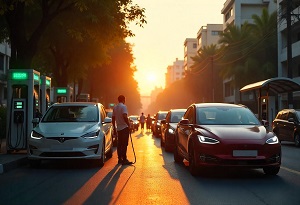
- Growing focus on electric mobility and gaseous fuels
- India targets net-zero emissions by 2070
Reliance Industries Forecasts Change in Fuel Dynamics
Harish Mehta, President of Strategy and Business Development at Reliance Industries, shared insights during an event hosted by the Petroleum Planning and Analysis Cell (PPAC).
Mehta emphasized that the energy transition in India is not just a possibility but an inevitable reality.
“Energy transition is absolutely on the cards. In our country, it is not going to be one fuel which is going to be dominant,” he said.
This statement underlines India’s commitment to a diverse energy mix, integrating renewables, electric mobility, gaseous fuels, and more sustainable alternatives to traditional petroleum-based fuels.
India to Lead Global Oil Demand Growth in 2025
As per global projections, India is set to overtake China in oil demand growth in 2025. With a rapidly expanding middle class, rising vehicle ownership, and urbanization,
the short-term fuel demand is expected to surge. However, the long-term trajectory indicates a gradual move away from fossil fuels.
Why India’s Fuel Demand is Growing Rapidly:
- Rapid urbanization and infrastructure development
- Increasing per capita income and vehicle sales
- Industrial and commercial growth
- Expanding logistics and transportation sectors
Despite the immediate growth, policy measures, technological adoption, and environmental concerns are driving India toward a clean energy future.
Clean Fuel Future: LNG, CNG, Biogas, and EVs to Dominate

Reliance Industries pointed out that gaseous fuels and electric vehicles (EVs) will play a central role in the future of India’s transportation sector.
Future Fuels to Watch in India:
- Liquefied Natural Gas (LNG) – Ideal for long-haul transportation and commercial fleets.
- Compressed Natural Gas (CNG) – Widely adopted in metro cities for public transport and private vehicles.
- Compressed Biogas (CBG) – A renewable and sustainable fuel made from organic waste.
- Electric Vehicles (EVs) – Gaining momentum through government incentives and improved infrastructure.
This multi-pronged strategy ensures energy security, lower emissions, and aligns with India’s climate commitments.
India’s Net-Zero Target by 2070: A Driving Force for Energy Transition
India’s ambition to achieve net-zero carbon emissions by 2070 has propelled policy shifts, industry investments, and public-private collaborations.
Several measures are being taken to decarbonize various sectors, especially transportation and power generation.
Government Initiatives Supporting Clean Energy:
- Faster Adoption and Manufacturing of Hybrid and Electric Vehicles (FAME) Scheme
- National Green Hydrogen Mission
- Production Linked Incentives (PLI) for EVs and battery manufacturing
- SATAT Scheme for promoting compressed biogas
- Renewable Energy Targets: 500 GW non-fossil capacity by 2030
Reliance Industries’ Role in India’s Energy Evolution
As a leading energy player in India, Reliance Industries is actively investing in green energy technologies, including solar, hydrogen, and biofuels.
The company’s New Energy division aims to position India as a global leader in the green energy transition.
Reliance’s Clean Energy Commitments:
- Investment in green hydrogen production
- Establishing giga factories for solar panels and energy storage
- Promoting carbon capture and storage (CCS) technologies
- Supporting EV charging infrastructure across major cities
Expert View: Energy Transition Will Be Fuel-Agnostic
Experts, including Harish Mehta, suggest that India’s energy future will not rely solely on one solution. Instead, a fuel-agnostic approach will guide the transition, focusing on affordability, accessibility, and sustainability.
“It will be a mix of technologies and fuels that will shape the energy roadmap. This is vital for a country as diverse and dynamic as India,” Mehta added.
Challenges in the Path Ahead
While the transition looks promising, India faces certain challenges:
- High upfront cost of EVs and infrastructure gaps
- Limited availability of CNG and LNG stations in rural areas
- Need for skilled manpower and R&D in clean technologies
- Balancing economic growth with environmental concerns
Overcoming these barriers will require continued investment, policy clarity, and stakeholder collaboration.
Conclusion: India at the Forefront of Global Energy Shift
India’s proactive approach in forecasting peak gasoline demand by 2035 and diesel demand beyond 2041 reflects a well-structured energy vision.
With government support, industry leadership from companies like Reliance Industries, and growing environmental awareness, India is well on its path toward a cleaner and greener energy future.