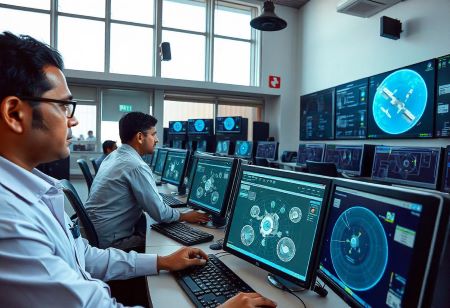
New Delhi: India is all set to revolutionize its time management system by shifting from GPS-dependent timekeeping to an indigenous satellite-based system powered by NavIC (Navigation with Indian Constellation).
This move aligns with the country’s mission to strengthen self-reliance and technological independence. The transition will mark a significant milestone as India adopts a synchronized time system that’s accurate to the millisecond.
Why the Shift from GPS to NavIC?
India currently relies on GPS satellites for its time synchronization, which links to Coordinated Universal Time (UTC).
However, this dependence on external systems has limitations, particularly in security, accuracy, and autonomy. By transitioning to NavIC, India can:
- Enhance Security: Reduce reliance on foreign satellite networks for critical infrastructure.
- Boost Accuracy: Achieve millisecond-level precision for various applications.
- Strengthen Self-Reliance: Promote the use of indigenous technology under the ‘Aatmanirbhar Bharat’ initiative.
- Improve Connectivity: Establish a robust time synchronization system across the nation.
What is NavIC?
NavIC, short for Navigation with Indian Constellation, is an Indian satellite navigation system developed by ISRO (Indian Space Research Organisation).
It consists of a constellation of seven satellites and offers precise positioning and time synchronization services in India and the surrounding regions.
NavIC has been designed to cater to both civilian and military needs, making it a critical component of India’s technological infrastructure.
How the New System Will Work
The transition to NavIC-based timekeeping involves a sophisticated network of atomic clocks, fiber optic links, and satellite communication. Here’s how the system will function:
- Time Reference from NavIC: The National Physical Laboratory (NPL) in New Delhi will act as the primary time reference point, receiving accurate time signals from NavIC satellites.
- Central Lab in Faridabad: A specialized lab in Faridabad will serve as the central hub, receiving and processing time data from NPL.
- Optic Fiber Link Distribution: The Faridabad lab will distribute the time data via optic fiber links to four regional centers located in Ahmedabad, Bengaluru, Bhubaneswar, and Guwahati.
- Regional Atomic Clocks: Each regional center will house an atomic clock to maintain precise time synchronization.
- Nationwide Synchronization: The synchronized time will then be disseminated across the country, ensuring uniformity and accuracy.
Benefits of ‘One Nation, One Time’ Initiative
The adoption of NavIC-based timekeeping will bring numerous advantages to India, including:
1. Accurate Timekeeping
- Precision timing is crucial for various sectors, including telecommunications, transportation, banking, and defense.
- Atomic clocks and NavIC’s millisecond-level accuracy will ensure seamless operations across industries.
2. National Security
- Reliance on foreign GPS systems poses security risks, especially in critical scenarios.
- NavIC’s indigenous system will safeguard India’s strategic interests and critical infrastructure.
3. Boost to Indigenous Technology
- Promotes the use of ‘Make in India’ technologies, supporting ISRO’s advancements in space research and development.
- Encourages domestic innovation and research in satellite navigation.
4. Economic Growth
- Accurate time synchronization will improve efficiency in sectors like stock markets, digital payments, and e-commerce.
- Reduces downtime and enhances productivity across industries.
5. Enhanced Connectivity
- The optic fiber network ensures reliable time distribution across urban and rural areas.
- Contributes to India’s goal of digital inclusion by providing uniform time synchronization.
Key Applications of the NavIC System
The ‘One Nation, One Time’ initiative powered by NavIC will benefit a wide range of applications, including:
1. Telecommunications
- Precise time synchronization is essential for mobile networks, internet services, and data centers.
- NavIC will ensure uninterrupted connectivity and improved network performance.
2. Transportation
- Accurate timekeeping will enhance operations in aviation, railways, and shipping industries.
- Facilitates real-time tracking and efficient scheduling of transportation systems.
3. Banking and Financial Sector
- Time synchronization is critical for secure and accurate transactions in digital banking, stock trading, and online payments.
- Prevents discrepancies and ensures smooth financial operations.
4. Defense and Security
- Reliable timekeeping is vital for military communications, navigation, and surveillance systems.
- Strengthens India’s defense capabilities and strategic autonomy.
5. Disaster Management
- NavIC’s real-time capabilities can assist in disaster prediction, response, and recovery.
- Enhances coordination among emergency services during crises.
Government’s Vision for ‘One Nation, One Time’
The Indian government’s push for ‘One Nation, One Time’ reflects its commitment to modernizing the country’s infrastructure and boosting technological self-reliance. This initiative is part of broader efforts to:
- Enhance India’s standing as a global leader in science and technology.
- Strengthen the nation’s digital infrastructure.
- Foster innovation and research in critical sectors.
Challenges and Way Forward
While the benefits of the ‘One Nation, One Time’ initiative are immense, the transition is not without challenges. Key hurdles include:
- Infrastructure Development: Establishing optic fiber networks and atomic clock systems across the country requires significant investment and coordination.
- Technical Expertise: Training personnel to operate and maintain the advanced systems is crucial for success.
- Public Awareness: Educating stakeholders about the benefits and implementation of the new system will ensure smoother adoption.
To address these challenges, the government plans to collaborate with ISRO, research institutions, and private sector partners. A phased approach will ensure the successful rollout of the NavIC-based time synchronization system.
Conclusion
India’s shift to a NavIC-powered timekeeping system is a bold and visionary step towards achieving ‘One Nation, One Time’.
By embracing indigenous technology, the country is paving the way for a future that’s secure, accurate, and self-reliant. This initiative not only strengthens India’s technological foundation but also underscores its commitment to innovation and progress.
With the support of ISRO and other stakeholders, India is poised to become a global leader in precise time synchronization and satellite navigation.